Skip to content
Process
← Back to Finkenriek Cemetery

Finkenriek Cemetery · Hamburg-Wilhelmsburg

The history of the Muslim cemetery at Finkenriek

How relocating 41 graves for a motorway turned into a Muslim cemetery with its own washing and prayer house: why the project matters so much to families in Wilhelmsburg, who took it on, and how a stopgap became a place for generations.

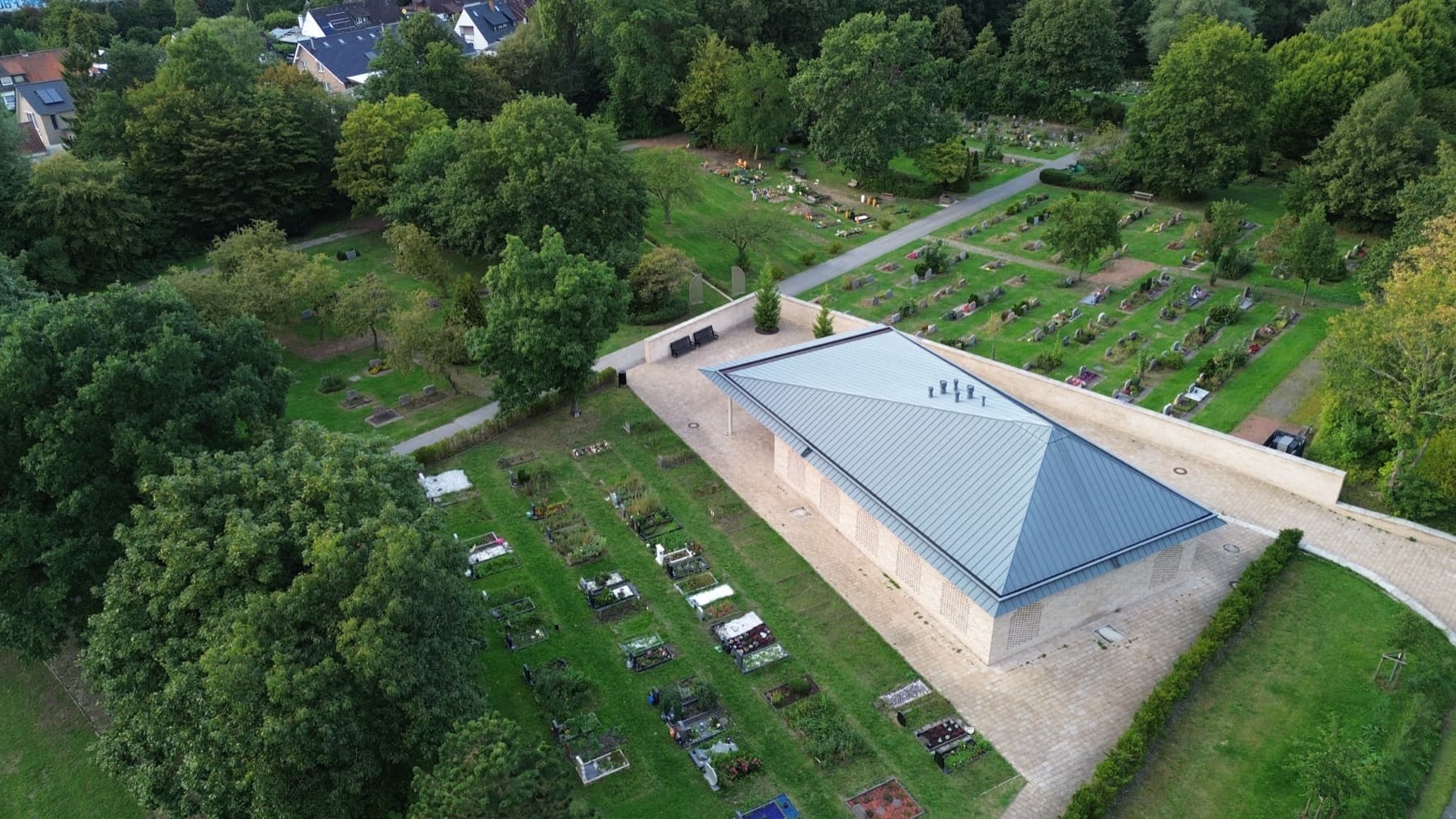
Aerial view of the Muslim prayer and washing house at Finkenriek Cemetery with the burial ground in front of it
The prayer and washing house with the Muslim burial ground, both aligned towards Mecca.Photo: Islamische Friedhöfe, drone photograph, September 2026

The story behind the project

A Muslim burial ground with its own washing and prayer house does not appear on its own. At Finkenriek it took a motorway, a politician who opened doors, and an entrepreneur from the community who was willing to do the work.

Why it matters

A place where Muslims can stay in Hamburg

Many Muslim families have lived in Wilhelmsburg since the 1960s, most with roots in Turkey. Their children and grandchildren were born here, they work here, they belong here. Yet when someone died, there was nowhere on the Elbe island where a burial according to Islamic rites was fully possible: no room for the ritual washing, no space for the funeral prayer, only a small field with a few graves.

Most families therefore had their deceased repatriated to Turkey. That is expensive, it takes days, and afterwards the grave lies thousands of kilometres away from the relatives. A Muslim cemetery with its own washing house on the doorstep means the dead stay where their families live, and the families can visit their graves.
Why this project

More than moving graves

In 2017 it becomes clear that the planned A 26 Ost motorway is to run directly beneath the old Muslim burial ground at Finkenriek. 41 graves are in the way. The simplest option would have been to move the graves to another part of the cemetery and leave it at that.

That is exactly what was not supposed to happen. If graves had to be opened, which Islam permits only in exceptional cases, then the deceased should go to a dignified, permanent field: in untouched soil, facing Mecca, and with the washing and prayer house the communities had been asking for for around fifteen years. A relocation thus became a new beginning for Muslim burial in the south of Hamburg.

„There is a real difference between having to demolish an ordinary house and having to relocate the dead in the process. For the relatives, that is an enormously heavy emotional burden.“

Daniela Jung, project manager, DEGES, speaking to NDR

The person behind it

Osman Kimil: someone had to do it

Osman Kimil is an entrepreneur in Hamburg who has been actively involved in religious matters of the Muslim communities for years. He knows the mosque associations, the imams and the families, and over the years he has built up many contacts in politics and public administration.

When the question arose of who would take charge of the project on the Muslim side, no one else in the community was willing to devote themselves to the task. A project like this means years of talks, countless meetings and responsibility towards families whose relatives are being reburied. Osman Kimil took on this work.

2017: The beginning

Dr. Herlind Gundelach approaches Osman Kimil

Former Hamburg senator Dr. Herlind Gundelach knew Osman Kimil through his work for the communities. When the motorway plans are settled in 2017, she approaches him: the project should be done properly, not as a mere relocation of the graves but as a complete Muslim cemetery with a washing and prayer house.

Together the two set the project in motion: Gundelach with her connections in politics and administration, Kimil with the backing of the Muslim community. Their aim is also to present the project to the Muslim community and involve it from the very start.

More than a year of planning

What is permitted, and how is it done?

Before the first stone is laid, more than a year passes on planning alone. Around the table sit the Muslim communities and their imams, the City of Hamburg, urban planning and DEGES as the motorway's developer. Osman Kimil handles the organisation on the Muslim side: he brings the parties together, collects the questions and takes the answers back to the communities.

The questions are fundamental religious ones: under what conditions may graves be relocated? How must the deceased be treated in the process? How can it be ensured that burials in the new field take place in untouched soil and that the rest of the dead is preserved permanently? How large must the washing room be, how are women and men kept separate, where is the funeral prayer said, and how is everything aligned towards Mecca? At the imams' request, the design comes from a Muslim architect: Medine Altiok from Zurich.

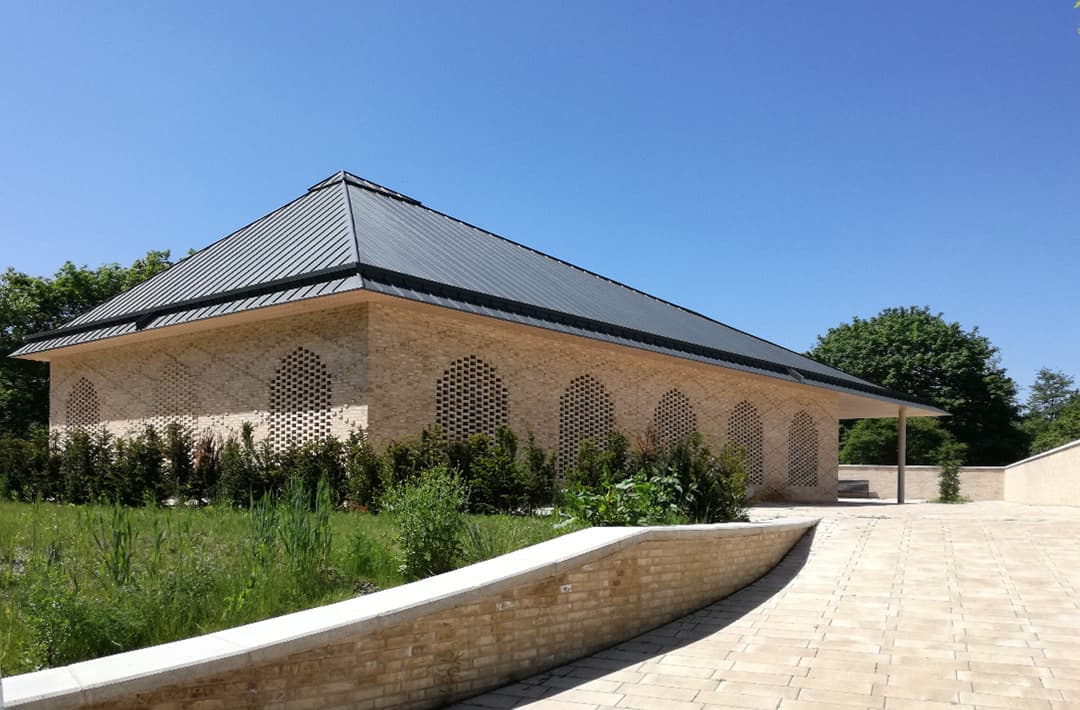
The façade of the prayer and washing house with diamond pattern and mashrabiya lattices in brick
Diamond pattern and brick lattices: the finished façade as Medine Altiok designed it.Photo: Islamische Friedhöfe archive

Why he got involved

“The deceased should stay here in Hamburg”

Osman Kimil gave his own answer to that question when speaking to NDR at the handover in summer 2020. For him, it was about Muslims being able to find their final rest in the city where they lived, and about their families being able to visit the graves without travelling to another country.

On top of that came the responsibility towards the families of the 41 deceased who had to be reburied. If their graves were going to be opened, something lasting should come of it in the end, something that would also serve the generations to come.

„For me personally, it was very important that the deceased can stay here in Hamburg and do not have to be taken back to their countries of origin.“

Osman Kimil, representative of the Islamic communities in Wilhelmsburg, speaking to NDR at the handover in 2020

„Home is where your dead lie buried.“

Saying, author unknown
The newly completed prayer and washing house in summer 2020 with the still empty burial field
Summer 2020: the house is finished, the burial field in front of it still empty.Photo: Islamische Friedhöfe archive

The result

2020: everything in one place

On 28 July 2020 the washing and prayer house is handed over to the Islamic communities together with 104 new graves. Since then, a complete Islamic burial has been possible at Finkenriek: washing, funeral prayer and burial without a coffin, in a grave facing Mecca. The building is later nominated for and wins several architecture awards. The chronicle at the end of this page shows, step by step, how it all came about.

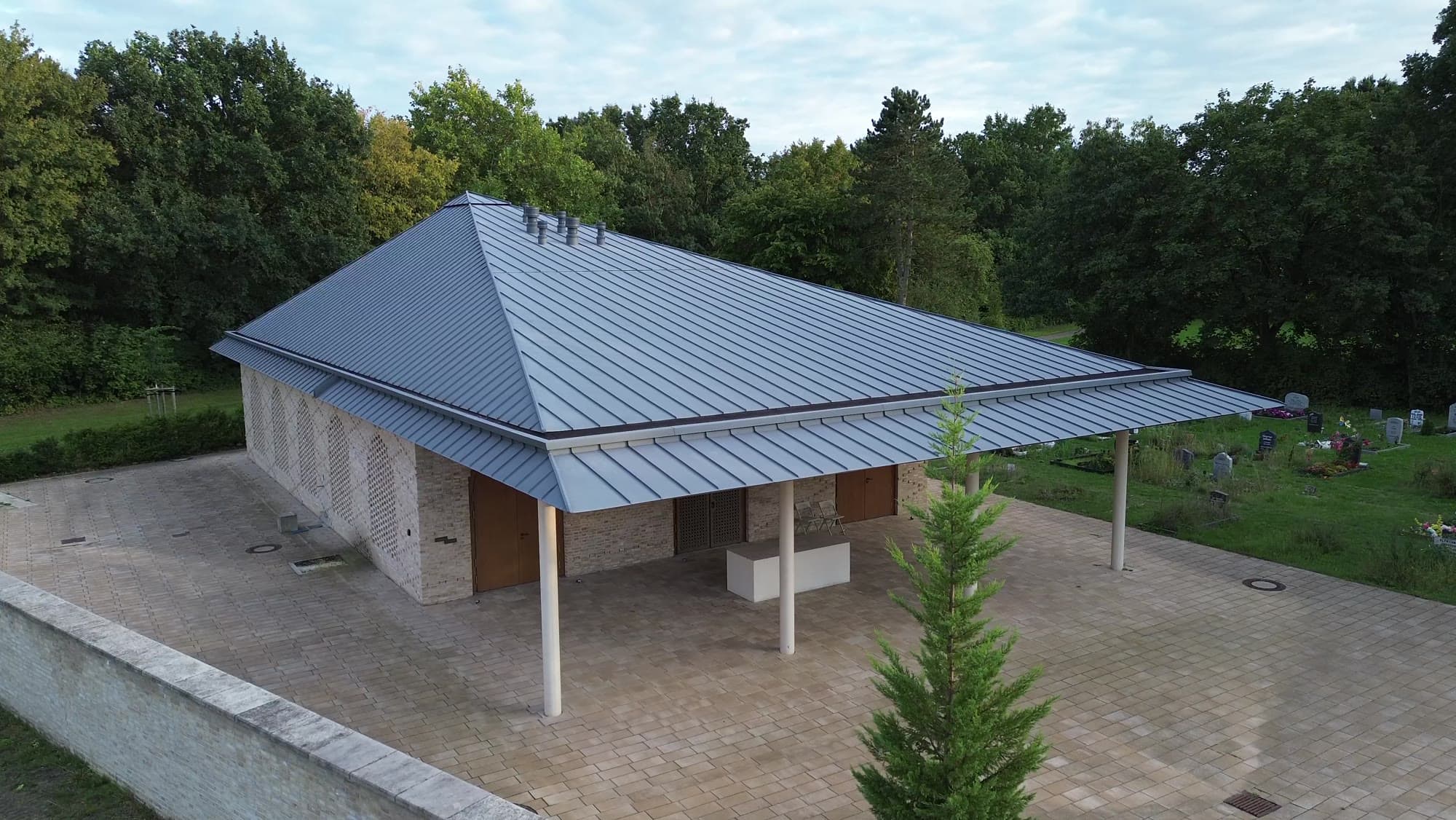
The prayer and washing house with tent roof and covered forecourt, seen from above
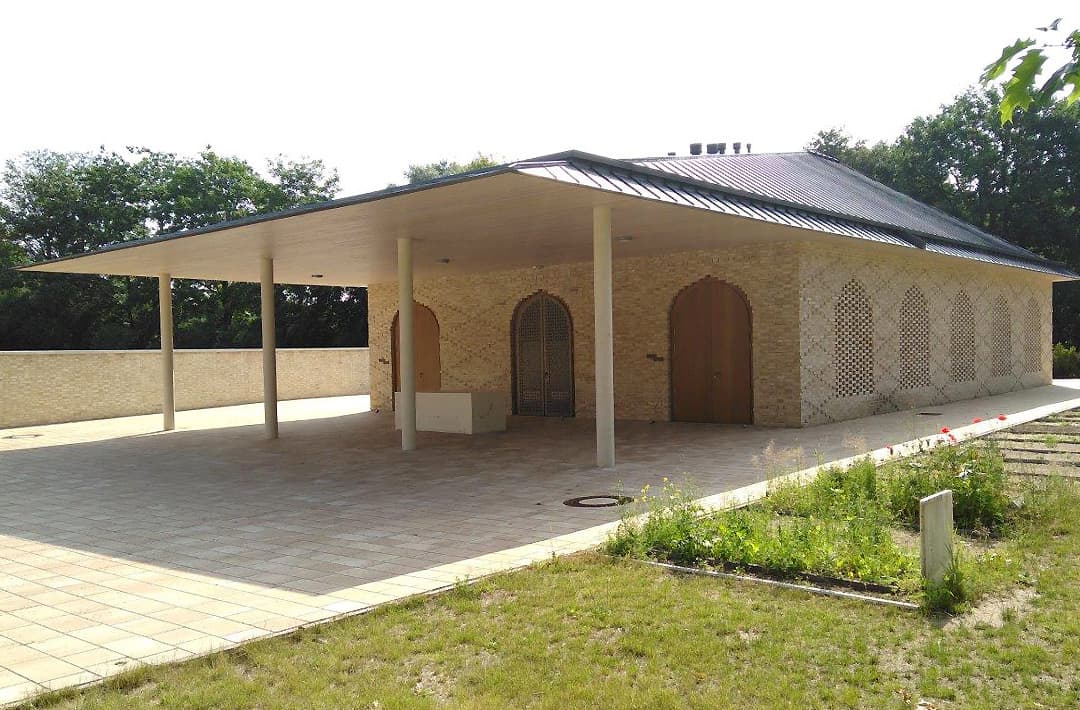
The award-winning house today: zinc tent roof, sand-coloured brick, covered forecourt.Photo: Islamische Friedhöfe, drone photograph, September 2026

At a glance

Project start
2017, triggered by the A 26 motorway plans
Planning phase
more than a year, 2017 to 2018
Set in motion by
Osman Kimil and Dr. Herlind Gundelach
Graves relocated
41 from the old field, November 2019
New burial ground and washing and prayer house
handed over on 28 July 2020
Graves today
104 (first phase), up to 540 when complete
Built and paid for by
DEGES, around €2.2 million, as compensation for the A 26
Years of waiting for a washing house
around 15, from 2005 to 2020
First grave facing Mecca
2000s, at the request of the Muslim community

Who was involved

The Muslim cemetery is the result of many contributors: communities, politicians, administration, planners and tradespeople. The most important at a glance.

  • Osman Kimil

    Hamburg entrepreneur active in religious matters of the Muslim communities; from 2017 organised the project on the Muslim side and accompanied the planning, the relocation and the new building

  • Dr. Herlind Gundelach

    Former Hamburg senator; approached Osman Kimil in 2017 and set the project in motion together with him

  • Imams and representatives of the Muslim communities in the Süderelbe area

    Called for the washing house, agreed the relocation, room programme and design, and helped choose the architect

  • DITIB, SCHURA and VIKZ

    Contracting parties to the 2012 Hamburg Staatsvertrag (state treaty), which governs burials according to Islamic rites

  • DEGES Deutsche Einheit Fernstraßenplanungs- und -bau GmbH

    Client and overall planning on behalf of Hamburg; project management Daniela Jung

  • Free and Hanseatic City of Hamburg, Ministry of Economy, Transport and Innovation

    Commissioning authority for the motorway project, publisher of the public information leaflet

  • Bezirksamt Hamburg-Mitte (district office), Finkenriek cemetery administration

    Operator of the cemetery until 2024, coordination of the burial ground and its operation

  • Medine Altiok Architektur, Zurich (Medine Altiok, Carol Kan)

    Design and lead planning of the prayer and washing house

  • asdfg Architekten, Hamburg

    Detailed design, tendering and construction supervision

  • Cemterra GmbH (Heinrich Kettler) and Brandenfels, Münster

    Cemetery and landscape planning of the burial ground

  • Carola Görge, Hamburg

    Structural engineering

  • HLKSE Belp Ingenieure and Sineplan, Hamburg

    Building services engineering

  • Applied Acoustics GmbH, Gelterkinden

    Room acoustics of the prayer room

  • S/W Design, Zurich

    Signage (wayfinding)

  • Jens Franke, Hamburg/Berlin

    Architectural photography

  • Hamburger Friedhöfe AöR

    Operator of the cemetery since 1 January 2025

The prayer and washing house in detail

The key facts about the building.

Address
König-Georg-Deich 24, 21109 Hamburg
Planning and construction
2017 to 2020, foundation stone May 2019, handover 28 July 2020
Usable floor area
around 220 m² on a plot of 2,300 m², eaves height 3.70 m
Rooms
washing room, farewell room, two waiting rooms, sanitary facilities, building services, covered forecourt with funeral stone
Entrances
two entrances of equal standing, separate for women and men, ornamented double door from the washing room to the forecourt
Orientation
building and graves aligned in the direction of prayer towards Mecca
Materials
sand-coloured clinker brick with ornamental brickwork, tent roof of pre-weathered zinc, lime plaster, oak, cement tiles
Special features
two domes in the ceilings, gilded prayer niche and dome, specially designed carpet, acoustic curtain to divide the prayer room
Construction cost
around 2.2 million euros

Awards

  • BDA Hamburg Architektur Preis 2022, honourable mention
  • DAM Preis für Architektur in Deutschland 2022, shortlist
  • Arc Award 2022, shortlist
  • EU Mies van der Rohe Award 2022, nomination
  • Tag der Architektur 2021, selected project
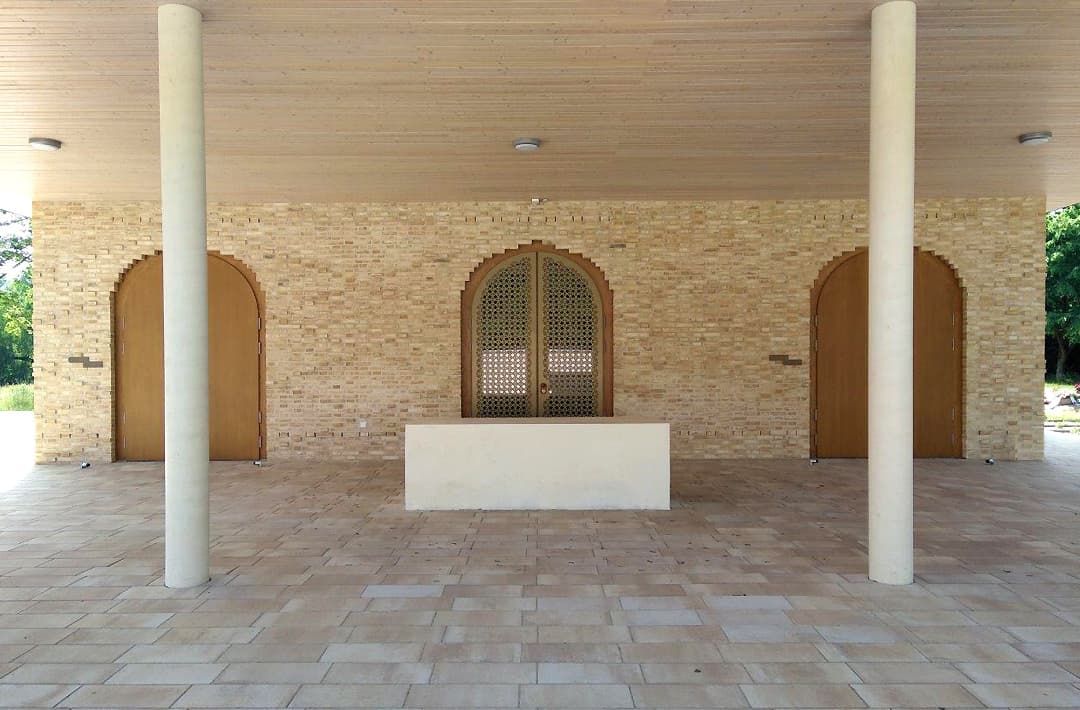
The covered forecourt with the funeral stone in front of the ornamented double door of the washing room
The funeral stone under the canopy: here the deceased is laid out for the funeral prayer. The separate entrances are to the left and right.Photo: Islamische Friedhöfe archive

The chronicle in brief

The key milestones, from the first Muslim families in Wilhelmsburg to today. Sources are listed at the end of the page.

  1. 1960s to 1990s

    Muslims in Wilhelmsburg, but no place for their dead

    From the 1960s, many Muslims come to Wilhelmsburg as so-called guest workers. Islamic burial grounds exist in Hamburg only at Ohlsdorf (since 1941) and Öjendorf (since 1978), and ritual washing is only possible at the Ohlsdorf crematorium. Most families have their deceased repatriated to Turkey.

  2. 2000s

    The first grave facing Mecca

    At the request of the Muslim community, the first grave is dug at the edge of the cemetery, aligned towards Mecca with a compass. It grows into a small field in grave sections 25 to 27, which reaches 41 graves by 2017.

  3. 2005 to 2016

    Calls for a washing house

    Muslim associations and mosque communities call for a washing and prayer house in Wilhelmsburg. The Hamburg-Mitte district assembly is supportive, but there is no money.

  4. 2012

    The Hamburg state treaty

    Hamburg becomes the first German state to sign a treaty with DITIB, SCHURA and VIKZ. Burial without a coffin becomes possible, and the rest of the dead is preserved permanently on Islamic burial grounds.

  5. 2017

    The A 26 and the start of the project

    The planned A 26 Ost is to run beneath the Muslim burial ground. Dr. Herlind Gundelach and Osman Kimil set the project in motion: instead of a simple relocation, DEGES builds a new burial ground and a washing and prayer house. In July 2017 the Hamburger Abendblatt presents the first design.

  6. 2017 to 2018

    More than a year of planning

    Communities, imams, the City of Hamburg, urban planning and DEGES agree on the relocation, the room programme and the religious requirements. Zurich architect Medine Altiok designs a building that combines Hanseatic and Islamic architectural traditions.

  7. May 2019

    Foundation stone

    The foundation stone is laid. The new burial ground is created on a former storage yard, in soil where no one has ever been buried.

  8. November 2019

    Relocation of the 41 graves

    The graves from the old field are relocated according to Islamic rules and in consultation with the relatives.

  9. 2019 to 2020

    Construction during the pandemic

    The building of sand-coloured clinker brick with a zinc tent roof goes up; the decisive construction phase falls during the first coronavirus lockdown.

  10. 28 July 2020

    Handover

    DEGES hands over the washing and prayer house and 104 graves to the Islamic communities. Construction cost: around €2.2 million.

  11. 2021 to 2022

    Awards

    Day of Architecture 2021, commendation at the BDA Hamburg Architecture Prize, shortlist for the DAM Prize and nomination for the 2022 Mies van der Rohe Award.

  12. 1 January 2025

    Transfer to Hamburger Friedhöfe

    Finkenriek passes from the Hamburg-Mitte district office to Hamburger Friedhöfe AöR.

  13. Today

    Room for the generations to come

    When fully developed, up to 540 graves will be possible. The A 26 Ost itself has not yet been built; the hearing in the planning approval procedure is scheduled for the end of 2026.

Burial at the Muslim cemetery at Finkenriek

Contact details, opening hours, costs and the steps of an Islamic burial at Finkenriek can be found on the cemetery page.